The AI divide is no longer between firms that use AI and those that don’t. The real divide is between firms that are running with commodity AI vendor solutions and those that are purposefully building their own proprietary AI platforms to create growth engines.
Differentiating between Commoditized AI and Proprietary AI is a critical first step for firms that truly want to be AI-First. This distinction guides firms on where to invest in proprietary AI versus adopting off-the-shelf solutions.
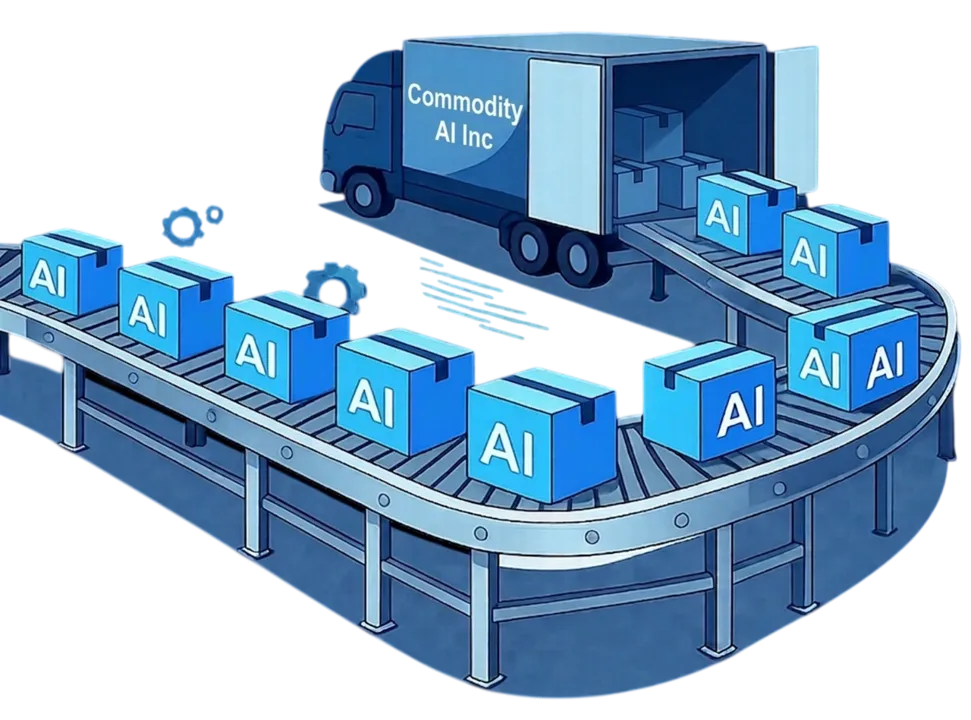
Commoditized AI solutions are becoming a utility for many firms. While they enhance productivity, they cannot create intellectual property that gives a lasting competitive advantage.
Think of the firms that raced to embrace email in the early 1990s, and then similarly digital web-based platforms in the 2000s. These technologies brought significant productivity gains, but eventually every firm implemented them. There was no meaningful long-term competitive advantage. Today, they are just the cost of doing business.
Similarly, AI solutions like GPT, Gemini, and Claude are incredible at general reasoning, summarization, and coding. However, every firm can buy the exact same API access for roughly the same price. These models, while amazing at what they do, offer limited long-term competitive advantage because every firm can access the same foundational models.
The real AI-First revolution is occurring in a second category: Proprietary AI Platforms
AI-First companies are building retrieval pipelines to feed specialized Small Language Models with structured and unstructured dark data. They then carefully integrate these with Large Language Models to maximize insights.
These firms are moving from just using canned vendor AI solutions, to building their own proprietary AI platforms to create real long term value.
A global logistics firm doesn’t gain an edge from AI by deploying a chatbot. It gains a competitive advantage by training its AI models on the decades of supply chain telemetry, weather patterns, and port latency data. They are creating new business models, optimizing the delivery of products into the hands of customers in ways that weren’t possible before AI.
Pharmaceutical companies aren’t beating the competition by giving employees access to public AI models — even those with enterprise privacy controls. They are mining internal chemistry models, molecular data, and clinical trial results. Their proprietary AI platforms are creating new drugs and developing treatments for diseases previously thought untreatable.
These aren’t just productivity gains. They enable entirely new business models and revenue streams.
Firms with a true AI-First mindset are using AI to build intellectual property moats that will compound over time and separate them from the firms that are doing some “AI stuff”.

Sophisticated AI-First firms are adopting a hybrid architecture, whereby they rent the massive reasoning power of commodity LLMs for general tasks, then they own and build specialized vector databases that define their core business logic. Think of it like renting a supercomputer for thinking, but storing intellectual property in a private vault.
This approach lets AI-First firms leverage advances in foundational models without surrendering ownership of their intellectual property.
A new generation of small and nimble startups such as Contextual AI, AI21 Labs, and Articul8 are helping large enterprises build these proprietary AI platforms. Rather than competing in commoditized AI markets, these small startup firms specialize in building retrieval pipelines, dark data mining, fine tuned RAG systems, and hybrid LLM/SLM architectures. Many operate under the radar, backed by venture capital, and are poised to become the AI powerhouses of the next decade.
Their value lies not in the commoditized vendor AI tools where there will inevitably be a race to the bottom on pricing, but in enabling corporations to convert their internal data into durable competitive moats.
Firms that rent the brain and own the memory are best positioned in the AI-First race.
Firms relying solely on a third-party AI subscriptions aren’t building an AI future, they’re just renting someone else’s.
Listen to a discussion on this article
This article was updated in Feb. 2026 to include references to Retrieval Pipelines, Gemini and Claude