For decades, Search Engine Optimization (SEO) has shaped the internet. It has influenced how we perceive brands and what products we buy. In the age of AI, the SEO era is fading fast. AI apps answer questions in ways that make internet search tools look dated. Welcome Generative Engine Optimization (GEO).
Historically, companies fought for rankings, backlinks, and keywords because in the traditional SEO search algorithms that’s what mattered. Those algorithms determined where products were shown in search results. If companies didn’t have a digital SEO strategy, they would be dead meat.
AI apps have stopped pointing users to search engines on web pages some time ago.
Instead, AI models are synthesizing information in multiple dimensions, taking into consideration third party citations, and then providing contextual answers. AI apps increasingly maintain persistent memory. This enables them to remember and learn about your personal preferences and needs. It also allows them to provide continuously better answers, tailored just for you.
McKinsey found that half of consumers are already using AI to search for products, and that number climbs rapidly for younger generations. Ahrefs report that 63% of websites now report traffic originating from AI based search engines.
Instead of searching for answers, people are simply asking AI to tell them what they need.
When an AI generates answers, it chooses just two or three brands or products. In the SEO age being in the top ten was good enough. In the GEO age firms need to be in the top three to stand a chance.
Rankings are no longer driven by SEO principles like keyword density or backlinks.
AI models prioritize firms and products by how well a company’s information is represented in retrieval pipelines. Data structure, freshness, and accessibility are key factors.
The game has shifted from optimizing for search crawlers to optimizing for AI reasoning.
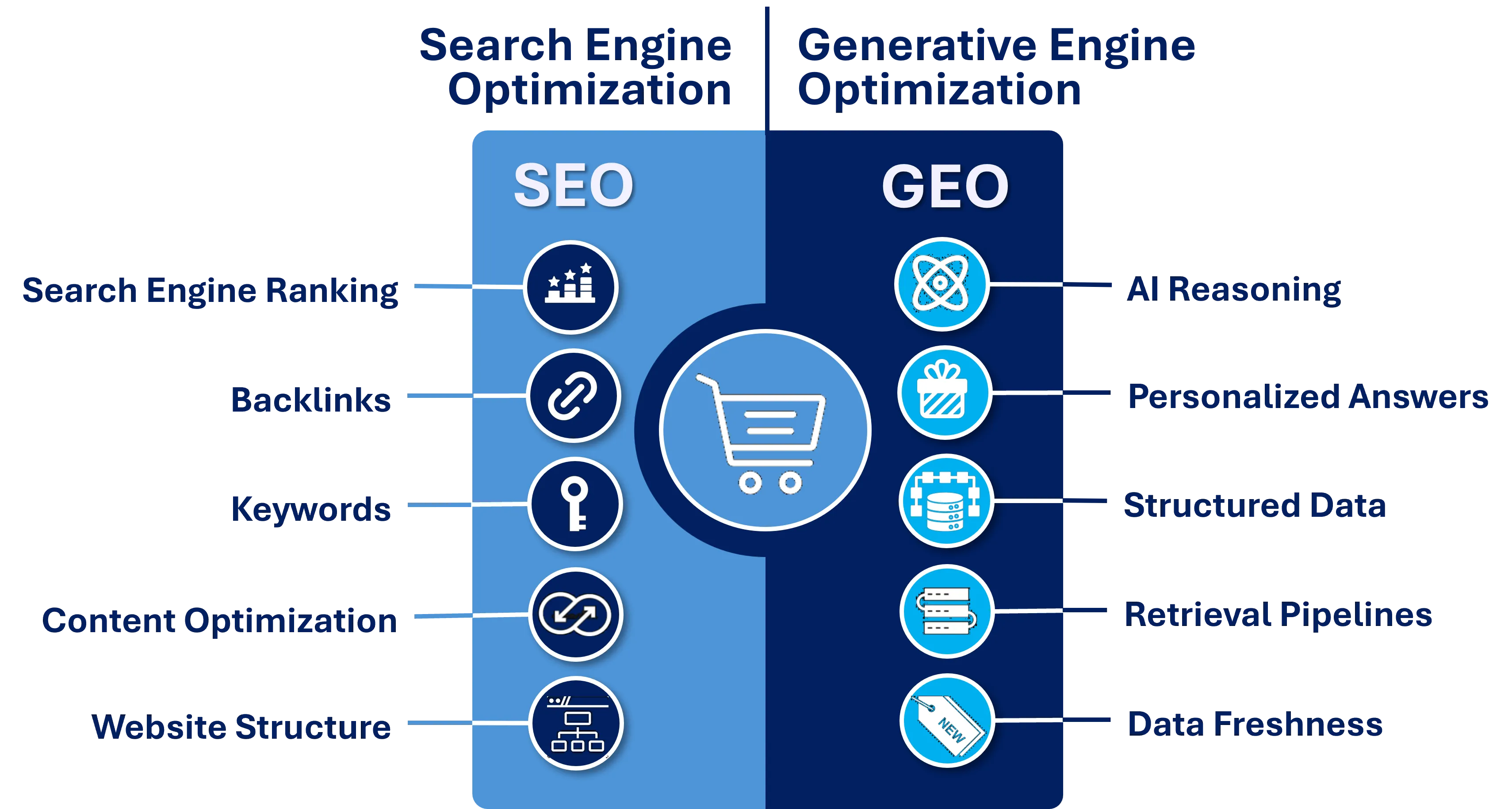
This is reshaping the multi billion dollar SEO industry, and it’s happening almost overnight. There’s a profound structural shift from chasing rankings to ensuring AI systems know that a firm even exists. Thereafter the AI models need information about a company’s products and why they are better than the competition.
Most firms don’t yet have a strategy for their own internal retrieval pipelines, let alone how to expose those pipelines to the outside world. (An API strategy for internal legacy structured databases doesn’t cut it.)
A GEO strategy is reliant on structuring data about firm’s brand and products so that AI systems can retrieve it, understand it, and more importantly trust it. Once an AI model trusts a brand it reinforces that choice and becomes much more likely to recommend its preferred brands in the future.
Early adopters are benefiting. Companies with clean, structured, high quality data, and strong retrieval pipelines are getting the best results. Their products are recommended, their expertise is cited more reliably, and they are becoming the leading choices for AI.
Firms that are struggling with their foundational client and product datasets are in trouble. The shift to GEO could make or break firms, with laggards struggling to make up lost ground.
Firms that don’t have sophisticated client and product datasets, and more importantly a solid and executable retrieval pipeline strategy, are going to find themselves in an increasingly lonely echo chamber.
AI is rapidly becoming the primary interface for humans to consume information.
AI is transforming how we consume information.
Firms that want to stay relevant need to rethink their digital strategy, define their GEO strategy, fine tune their client and product datasets for the AI age, and start executing on a robust retrieval pipeline strategy.