A major shift is underway in enterprise technology architecture. The application layer is collapsing into AI agents. Enterprise architectures have not seen a seismic shift like this since graphical user interfaces (GUI) replaced command-line computing.
Applications expanded rapidly in the 1990s and into the 2000s. Business teams gained direct access to real-time digital information through GUIs layered on top of enterprise databases.
This transformed how humans consumed information.
It’s easy to forget that paper was the primary business medium before the digital age. The laggards in the digital revolution eventually realized that their digitally savvy competitors were better informed and making faster decisions.
AI is challenging the legacy application model and will enable even faster and better decisions, and significantly better business outcomes.
Over the last three decades, humans have switched between multiple screens, and often multiple applications, to consume information: Looking at multiple CRM tabs, viewing complex dashboards, then perhaps using Excel to calculate an answer.
AI agents will navigate applications for humans and deliver outcomes.
AI agents are increasingly able to call multiple applications and databases in near real time, providing bespoke and concise answers to specific questions. This assumes firms have implemented robust AI governance frameworks. (See my April 10, 2026 article.)
Not only is this much more efficient, but it also provides a huge competitive edge. AI Agents will increasingly anticipate client needs and proactively assemble insights before a client need has even been fully formed.
This doesn’t mean applications will disappear.
Humans will still want the safety of validating the answers they get from AI agents. (There was a whole generation that preferred the comfort of paper over computer screens.)
However, the rapid advances in Agentic AI capabilities means that applications will start to move down the tech stack.
Consider a familiar workflow: The Head of Sales asks, “Our biggest client was just on the phone and they aren’t happy. How did our relationship with XYZ Corp trend this quarter versus last?”
Today that answer typically requires opening CRM, pulling engagement metrics from marketing apps, exporting data, combining engagement data with sales data, building a pivot table, and finally interpreting results. Some might look at dashboards that were refreshed days or weeks ago. Some might even ask the Analytics team to drop everything and scramble.
In an agentic AI world, the Head of Sales simply asks the question to their AI agent; either typed into their laptop or spoken into a microphone on their smartphone. The AI agent queries CRM, marketing automation apps, and analytics systems, joins the datasets, explains the trend drivers, and almost instantaneously lines up a set of next best actions.
The applications will still exist but they are no longer the interface that humans need to drive business outcomes.
Enterprise software firms have historically competed on screens and ease of navigation. Agentic AI platforms compete with context, reasoning, and orchestration.
The battlefield for software firms is moving from user experience to execution intelligence with context.
The impact on technology strategy is profound.
For decades architectures have been built around application-centric integration. Architectures are now shifting toward agent-centric orchestration.
How AI agents interact with each other and applications is critical.
There have been rapid advances around Model Context Protocol (MCP). This is an open standard that allows AI agents to interact with applications and data sources. MCP allows software providers to integrate their applications with AI agents in a consistent and scalable way, reducing complexity and improving time to market. While still evolving, MCP is likely to accelerate agentic AI adoption.
There’s also the thorny question of identity models. Previously, firms controlled access by knowing who logged into an application. In the future, they will need to control access rights for AI agents. That includes knowing where the original query was submitted, along with what other agents, applications and databases participated in the end-to-end orchestration.
Governance needs to expand from controlling user access to applications to controlling autonomous workflows.
The technology implications are much broader than the few examples above. There will be new jobs from this shift that we can’t yet imagine.
Business teams will experience an even bigger transformation.
Instead of learning how to navigate applications, they will need to learn how to collaborate with AI agents. That’s a big shift in mindset.
Perhaps even more profound is the colossal changes AI will bring to business workflows.
Just as the digital age brought huge changes to how business teams worked, AI will radically change how businesses drive outcomes. Smart firms will embrace this early. The old legacy ways of delivering outcomes just don’t apply anymore. AI will sweep away legacy ways of working and restrictions rooted in human capital.
Yet another new mindset is needed to reimagine corporate operating models.
In 1993 Michael Hammer and James Champy released Reengineering The Corporation. They implored firms to completely reimagine their business models for the digital age. They challenged Adam Smith’s division of labor, which up until that point had defined business operating models for more than 200 years since the Industrial Revolution.
A similar but far more agile approach is now required for AI.
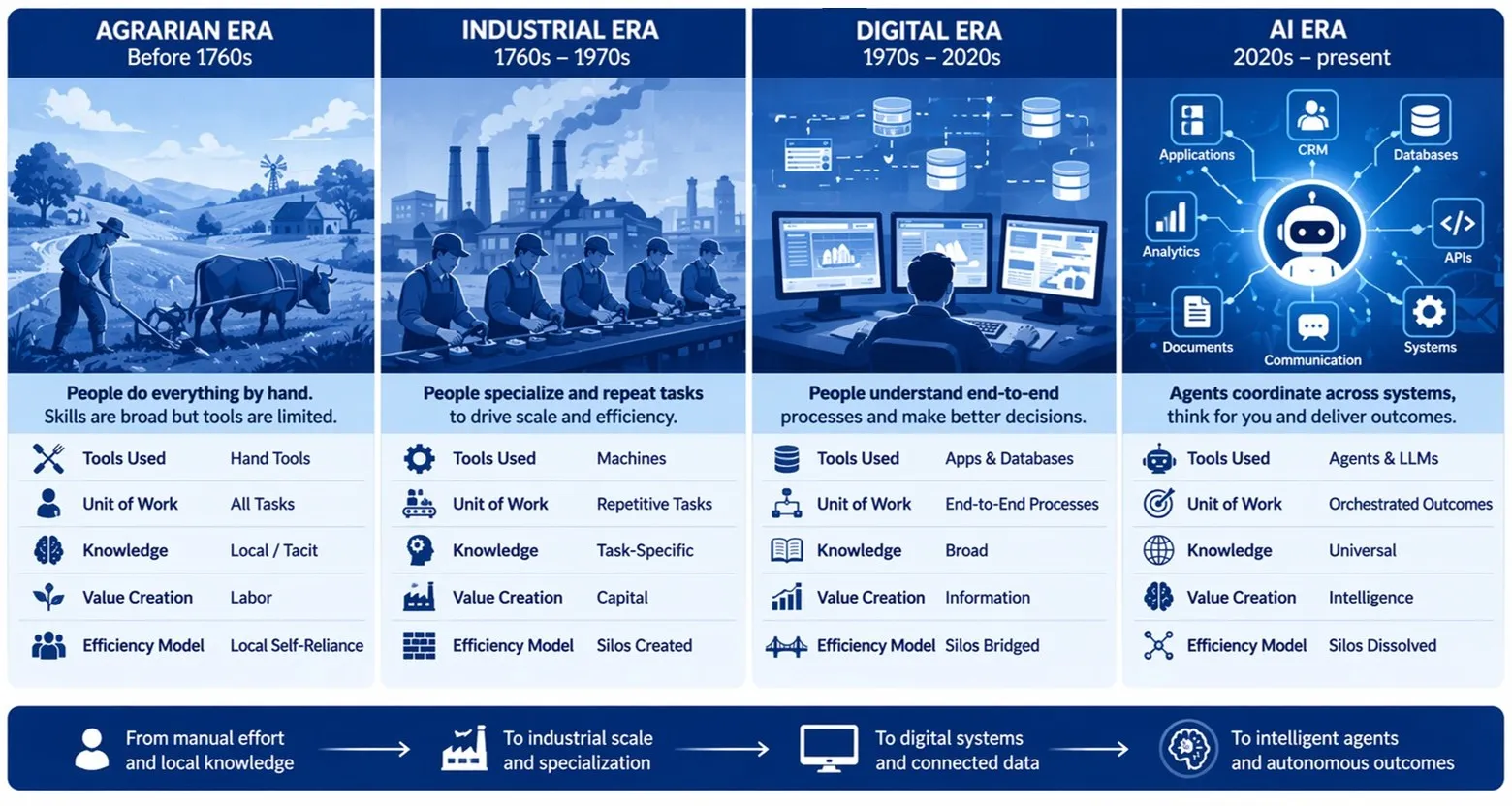
The true pioneers will go one step further and invent new products on the back of AI technologies.
Some applications are going to be impacted by AI before others.
Reporting layers, dashboards, and workflow tools exist largely because humans need structured interfaces to interpret data and make decisions. Agents will remove that requirement by calling systems directly through retrieval pipelines and tool integrations and then explain results in context. Agentic AI goes on to make decisions previously made by humans.
In the coming years, most large firms will introduce AI agents for analytics, client coverage, and operations. These agents will increasingly become the primary interface for retrieving insights across multiple systems. Business teams will eventually come to regard the dashboards and reports we use today as old school solutions.
Within the next decade, business teams will rarely log directly into core systems of record. Employees won’t open CRM. They will open a coverage agent. They won’t navigate reporting platforms. They will ask an insight agent. Clients won’t ask for a statement, they will ask an activity agent.
Applications will start to move lower down in the tech stack and closer to the infrastructure layer.
The firms that adapt fast and reap the rewards will treat AI agents as an entirely new layer that can drive better outcomes and create new products and services.
Firms that stick with yesterday’s interface will see their tomorrow disintegrate.
Listen to a discussion on this article