Neural networks are the engines of modern AI platforms. They are inspired by the structure of our own human brain: Recognizing patterns, learning, and making split second decisions without being explicitly programmed.
Rather than follow a fixed set of rules, neural networks adapt based on experience. This allows them to handle complex and uncertain information. They are flexible and dynamic.
Neural networks are made up of interconnected units called neurons. These neurons are typically arranged into three layers:
- An input layer that receives data
- One or more hidden layers to process information
- An output layer that produces a result
Each neuron has a numerical weight that represents how strongly it influences other neurons during processing. As information flows through the neural network, neurons apply mathematical transformations, enabling the model to capture complex, nonlinear relationships.
Each layer in the network transforms the data in a different way, and as the model learns, the neuron weights are continuously adjusted. This process allows the network to strengthen patterns that matter and ignore those that don’t.
That can sound abstract, so here’s a simple analogy.
In the human brain, we receive an input: Let’s say your eye sees an elephant.
In simplified terms, the neurons in your visual cortex activate, and then your brain quickly identifies the shape, size, and features of an elephant.
Neurons associated with “elephant” become active, while unrelated patterns fade. If the elephant suddenly turns and charges, the brain’s fear circuits activate intensely, triggering an immediate output: RUN!
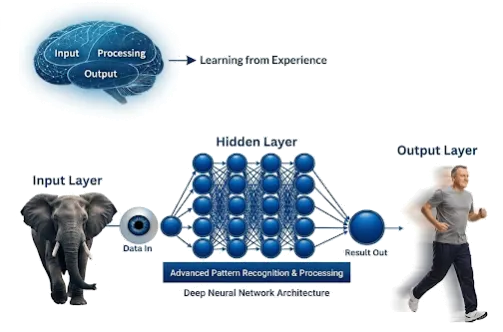
AI neural networks work in a similar conceptual way, though they are far less sophisticated than the human brain. At least for now.
Learning in an AI neural network occurs through training. (In humans, we call this life experience.)
During training, the network compares its predictions with correct answers and adjusts the weights of its neurons to reduce future errors. This mathematical process allows the neural network to improve over time.
Neural networks are exceptionally good at handling large amounts of information and variation in near real time. This level of computation only became possible with recent advances in processing power.
Today, neural networks are everywhere. They enable computers to recognize faces. In natural language processing, they allow AI to understand and generate human like text. In medical imaging, they can spot cancer cells. Autonomous vehicles heavily rely on neural networks to interpret complex signals and make rapid predictions as they navigate roads.
Despite their success, neural networks are not as intelligent as humans. They do not understand meaning or possess awareness. They identify patterns to make informed guesses.
However, their ability to learn from experience has made neural networks a critical component of modern AI platforms.
As chip processing power continues to grow, advances in the capabilities of neural networks will likely be key to the next wave of AI.