A new AI app seems to appear every day, each one filling a niche in an increasingly overcrowded marketplace. Most distinguish themselves by the front-end workflow they support rather than the sophistication of their back-end AI model.
Andreessen Horowitz, a venture capital firm in Silicon Valley, is already on the sixth revision of their report on the top 100 AI apps. Microsoft’s Marketplace has a dizzying choice of AI apps.
This moment in AI’s evolution has strong echoes to the early days of the internet.
In the 1990s, consumers faced a confusing array of internet service providers (ISPs). America On Line, CompuServe, and EarthLink were just a few that clamoured for customers with claims of more reliable and faster service. Under the hood, they all did the same thing.
The same fragmentation occurred in the early 2000s with search engines. Firms like AltaVista, Lycos, and Yahoo aggressively competed against each other. Under the hood, they all did the same thing.
Then came a massive wave of consolidation.
Telecom giants gobbled up the ISPs and rolled internet access into consumer’s existing phone services. They even issued customers with one combined bill.
Google had a simple search bar on an almost blank home page with no advertising. They buried the competition. The search engine war was officially over in 2006 when “Google” was added to the Oxford English Dictionary as a verb.
Consumers didn’t want to stumble through the back-end mechanics of connecting to the internet. Nor did they want complicated search websites.
All they wanted was simplicity.
Two decades later, AI is barreling towards a similar consolidation.
Some analysts suggest there will be a consolidation of the back-end models. That will then lead to a small number of foundational AI models powering a multitude of front-end tools. This is the same utility model AWS and Microsoft Azure offer; they provide back-end cloud services to host a vast front-end ecosystem of third-party applications.
From a consumer’s point of view, the murky back-end AI models all do the same thing. (It’s actually a lot more complicated, but the point is consumers just don’t care.)
Other analysts argue that front-end AI apps are ripe for consolidation. There are thousands of apps competing against each other to support the same overlapping workflows. They all essentially do the same thing. They can’t all survive when all consumers want is simplicity.
The consolidation pressure isn’t coming from market forces alone.
AI legislation and corporate governance are about to insert a hard divide between personal and professional use of AI. People are loading corporate data into their consumer AI apps.
How many employees record their work meetings using an AI app on their personal phone, and then review an AI generated summary that also captures action items?
Lawmakers and corporations are poised to separate the AI ecosystem into two halves, making sure one half doesn’t leak confidential data into the other.
The almost endless choice of AI apps today does not make users’ lives easier.
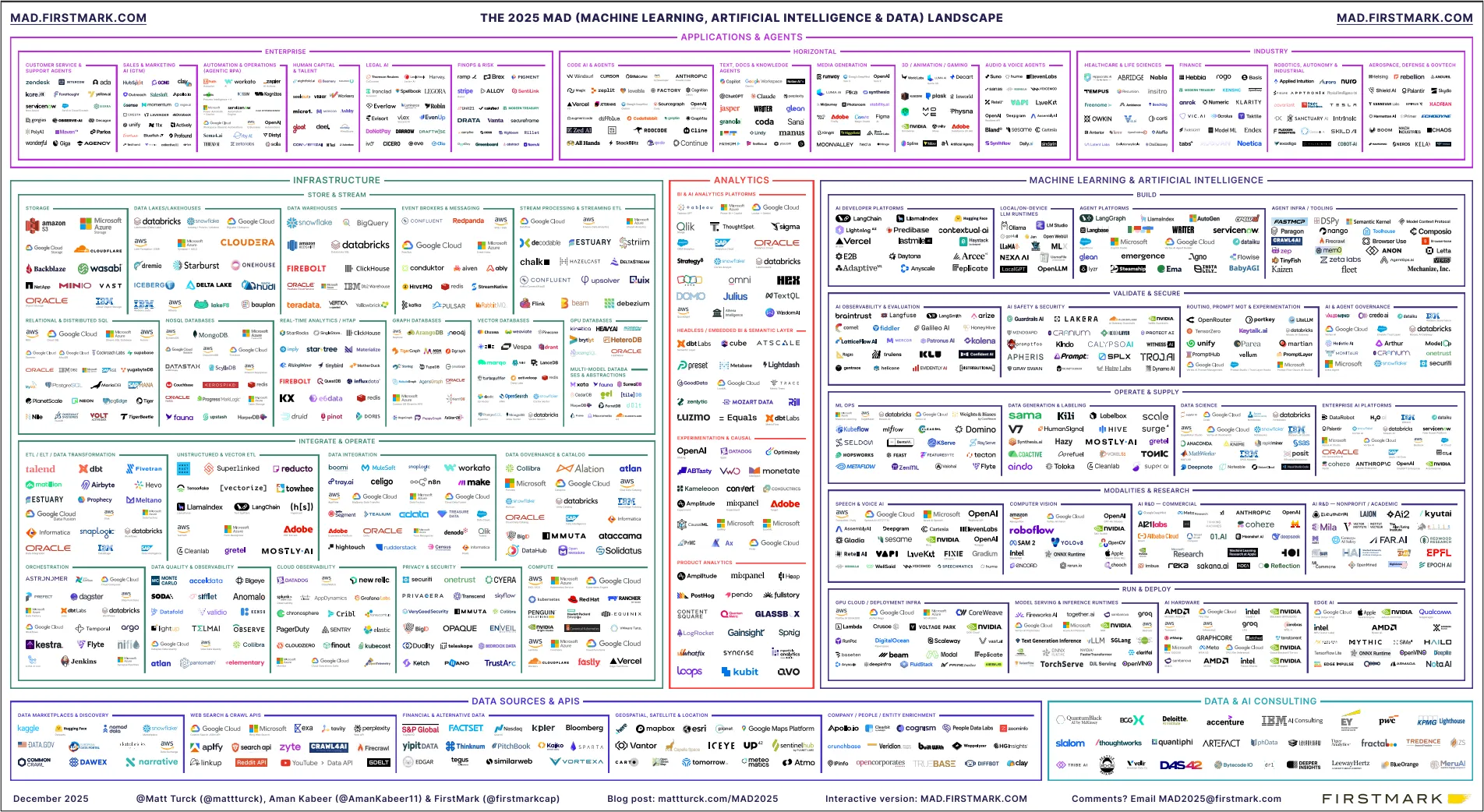
Consumers are confused. They don’t want to jump from one app to another.
Businesses are equally wary, fearful they are missing out while competitors leap ahead.
The consumer and corporate AI ecosystems are deeply intertwined, but when they diverge there are going to be two vastly different outcomes.
For consumers, the future of AI will likely come from a handful of mega firms. Apple, Meta and Google already hold deep datasets on their customers’ behaviors. They are best positioned to embed powerful AI experiences into the smartphones consumers already hold in their hands.
Consumers just want AI to work and make their life easier. They don’t want to navigate through a myriad of AI app choices, and they certainly don’t want to design an AI strategy.
Corporations don’t have that luxury. For corporations a coherent and executable AI-First strategy is mission critical.
The tangled complexity of the AI ecosystem is leading some firms towards a flawed approach: Chasing the AI buzz, trying out every latest AI app, and running multiple POCs with commoditized AI vendor solutions. They are focusing on the shiny stuff. The shiny front-end AI apps that are about to be both segmented and undergo a massive consolidation.
That’s a dangerous approach.
The focus should be on creating a proprietary AI platform to provide a meaningful competitive edge.
An AI-First platform takes the scalability of large language models for general reasoning and combines them with unique insights from proprietary small language models. Then there is the gritty work of building retrieval pipelines to ingest dark data in real time.
None of that sounds sexy.
It’s far easier for corporate leaders to focus on the shiny AI stuff on the front-end that everyone is chattering about in the consumer domain.
The compelling lesson from ISP and search engine consolidation is not which firms survived in that space, but how smart businesses built on the back of those foundational technologies to create new solutions.
Firms like Expedia, Netflix, Salesforce, and Bloomberg used the foundational internet technologies to build proprietary platforms and new business models. They saw the bigger picture: By buiding proprietary platforms on top of those foundational technologies they were able to provide consumers with new products they didn’t even know they needed.
That first-mover advantage proved decisive.
AI will consolidate in some form.
The bubble we are living in today where anyone can release an app and call it “Artificial Intelligence” will eventually burst.
The firms that have a solid AI-First strategy to build their own proprietary AI platform will be the firms still standing when the dust settles on the AI landscape.
Listen to a discussion on this article